How Cats Communicate With Their Owners
Discover how cats communicate with their owners using meows, body language, and subtle rituals to build a deeper, more trusting bond with your pet.
Cats Are Talking All the Time
Many people describe cats as independent, private, or even unreadable. Compared with dogs, they can seem subtle in the way they express themselves. But anyone who lives with a cat knows that “subtle” does not mean silent. Cats communicate with their owners all day long, often in ways that are easy to miss until you start paying attention.
A cat’s communication style is a layered mix of vocal sounds, body language, physical contact, and habit. One meow can mean a greeting, a demand, a complaint, or pure curiosity depending on the situation. A tail held upright can signal confidence and friendliness, while the same cat crouched low with flattened ears is clearly saying something very different. Cats are always offering information. The challenge for owners is learning the language.
What makes feline communication especially interesting is that cats often tailor it to humans. Research and everyday experience both suggest that cats do not interact with people exactly the way they interact with other cats. They learn what gets our attention, what earns them food, and what invites affection. In a real sense, your cat is studying you just as much as you are studying it.
The Meaning Behind Meows, Purrs, and Other Sounds
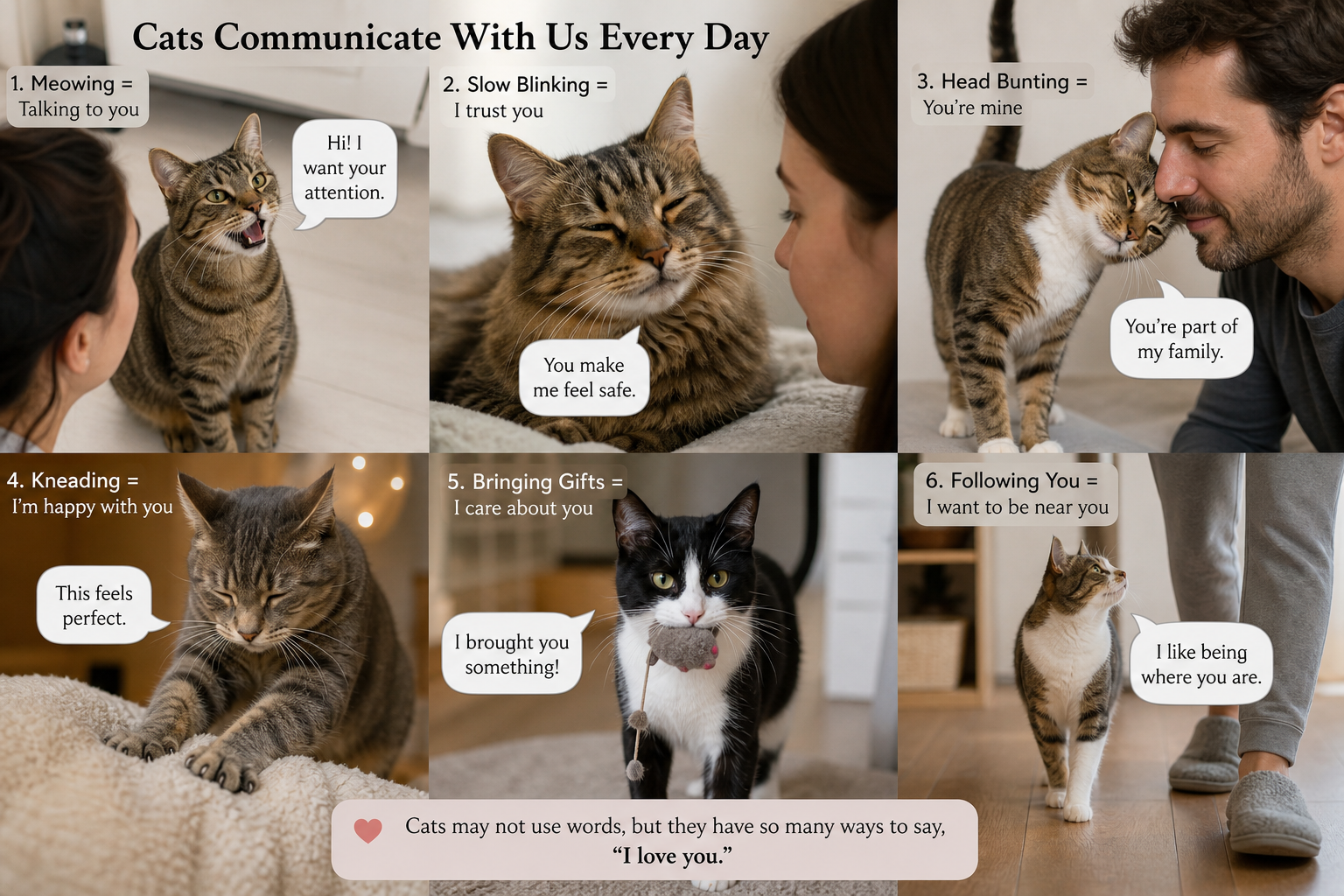
One of the clearest ways cats communicate with owners is through vocalization. Adult cats do not always meow much to each other, but many meow frequently at humans. This suggests that meowing is, in part, a specialized social tool used to get our attention.
Not all meows are the same. A short, soft meow may simply be a hello when you walk into a room. A repeated, insistent meow near the food bowl usually needs no translation. A drawn-out yowl may signal stress, discomfort, or a desire to go outside. Over time, owners begin to recognize the distinct patterns in their own cat’s voice. Some cats are chatty and expressive, while others save their sounds for specific moments that matter to them.
Purring is often treated as a universal sign of happiness, and it certainly can express contentment. A cat curled up beside you, eyes half-closed and paws kneading a blanket, is likely communicating comfort and trust. But purring is more complicated than many people realize. Cats may also purr when they are anxious, injured, or seeking reassurance. In those moments, purring may function as a self-soothing behavior as much as a social signal.
Cats also chirp, trill, hiss, growl, and chatter. A trill is often a friendly sound, sometimes used as a greeting or invitation to follow. A hiss is a clear warning: back off. Teeth chattering at a window may show excitement or frustration at birds beyond reach. The important point is that sound alone rarely tells the whole story. Tone, timing, and context matter just as much.
Body Language Says Even More
If meows are the headline, body language is the full article. Cats communicate enormous amounts through posture, tail position, ear movement, eye contact, and facial tension. Owners who learn to read these signs can respond more appropriately and build stronger trust.
The tail is especially expressive. A tail held high often signals confidence and a positive mood, particularly if the cat approaches you with a relaxed body. A puffed-up tail suggests fear or alarm. A tail lashing back and forth usually indicates agitation, overstimulation, or irritation. Many people misread this as playful excitement when it can actually mean the cat is nearing its limit.
Ears are another useful clue. Forward-facing ears often suggest interest or calm attention. Ears turned sideways or flattened back can indicate discomfort, fear, or defensive aggression. The eyes matter too. Slow blinking is often interpreted as a sign of trust and relaxation. Many cat owners return the gesture, and cats sometimes appear to respond positively. A hard, unblinking stare, by contrast, can feel threatening.
Posture ties everything together. A relaxed cat may stretch out, expose its side, or move fluidly around you. A frightened cat may crouch low, make itself small, or freeze. An overstimulated cat may suddenly tense up while being petted, even if it seemed content seconds earlier. Recognizing these transitions is essential. Cats usually communicate their boundaries before they scratch or bite; humans just do not always notice in time.
Touch, Scent, and Everyday Rituals
Cats communicate not only through what we hear and see, but also through touch and scent. When a cat rubs its face against your leg, hand, or furniture, it is doing more than asking for attention. Cats have scent glands around their cheeks, chin, and forehead, and rubbing deposits familiar scent. This is a way of marking territory, but in a social context it can also be read as a form of bonding. Your cat may be saying, in effect, “You are part of my world.”
Head bumps, or bunting, are often affectionate gestures. Kneading with the paws can signal comfort, security, and pleasure, often rooted in kitten behavior. Grooming can be communicative too. If a cat licks your hand or hair, it may be extending social grooming, a behavior associated with trust and affiliation.
Routine is another major language cats use. Cats are observant and pattern-driven, and they quickly develop ways to signal expectations. Sitting by the door at the same time each day, pacing near the kitchen before dinner, or hopping onto your desk when you have worked too long are all forms of communication. These rituals are not random. They are learned interactions shaped by repetition and response.
Owners often underestimate how much cats rely on consistency. Changes in appetite, litter box habits, hiding behavior, or social engagement can all be meaningful messages. Sometimes a cat that seems aloof is actually communicating stress, illness, or discomfort through withdrawal rather than noise. Paying attention to changed behavior is one of the most important parts of understanding a cat.
How Owners Can Respond Better
The best communication with a cat is a two-way process. Owners do not need to “train” themselves to decode every tiny movement, but they do need to observe without forcing human assumptions onto feline behavior. A cat that rolls onto its back is not always asking for a belly rub; sometimes it is showing trust while still protecting a sensitive area. Respecting that distinction can prevent a lot of misunderstanding.
One of the simplest ways to improve communication is to notice patterns. What does your cat do when it wants food, play, rest, or space? What signs appear just before it becomes irritated? What kind of touch does it enjoy, and when has it had enough? Every cat has an individual style, and owners who pay attention usually become fluent over time.
It also helps to answer a cat’s signals consistently. If you reward loud dawn meowing with breakfast, your cat will learn that this method works brilliantly. If you respect signs of overstimulation and stop petting before the cat feels trapped, trust grows. Clear, calm responses teach cats that communication is effective and safe.
In the end, cats communicate with their owners in ways that are both delicate and direct. They speak through voice, posture, gaze, scent, touch, and routine. Their language may not be as obvious as we sometimes wish, but it is rich and remarkably personal. The more closely we listen, the less mysterious cats become. And perhaps that is part of their charm: they are always talking, but they make us earn the privilege of understanding them.